Is your system arc flash compliant?
Arc flash is a serious hazard with potentially devastating effects. Keeping employees safe and meeting the challenges of the new arc flash safety requirements can be a difficult task.
Trust ERS’ experience to support your arc flash compliance needs. From hazard analysis and labeling to training and electrical safety guidance, ERS’ electrical service team helps identify hazards, reduce risk, and address applicable safety requirements.
The cost of inaction
An arc flash incident costs far more than a study
An arc flash study is a safety investment. The consequences of an arc flash incident extend well beyond the immediate injury, and most are preventable with a current, accurate assessment in place.
$1M+
Treatment cost per injured worker can exceed one million dollars, not including litigation, insurance increases, fines, investigation, or lost production.
400+
Electrical fatalities occur in the U.S. each year. Arc flash and arc blast account for a significant share, and most are preventable with proper hazard assessment and PPE in place.
2 weeks–6 months
An arc flash event can destroy switchgear and electrical equipment, requiring complete replacement and extended production downtime to restore operations.
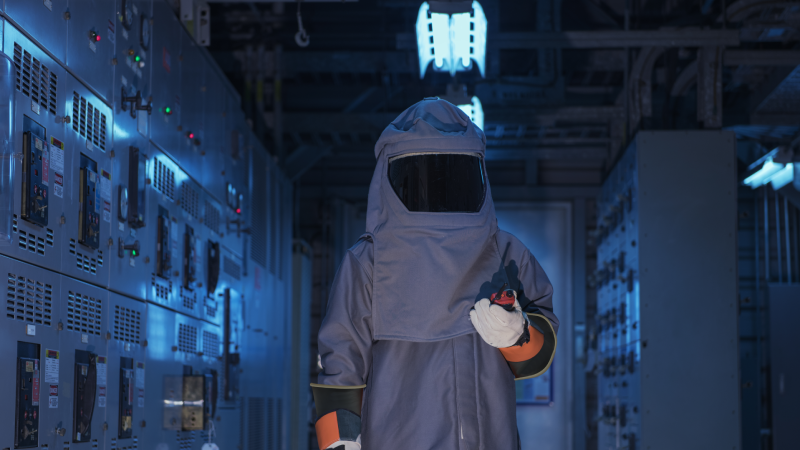
An arc flash is not a theoretical risk. When an arcing fault occurs, it releases concentrated thermal energy and pressure force in a fraction of a second, generating temperatures that can reach 35,000°F, reaching nearly four times the temperature of the surface of the sun, and expelling molten metal and debris at velocities exceeding 700 miles per hour. Workers have sustained serious injuries even when stationed ten feet or more from the source.
An arc flash study identifies where these hazards exist in your facility, calculates the energy involved at each location, and defines exactly what protection is required before anyone approaches energized equipment.
Arc flash standards and requirements
2026 NEC (Section 110.16)
The prior ampere-based threshold for arc flash warning labels has been eliminated. All electrical equipment that may be energized during service or maintenance now requires a label, regardless of ampere rating.
NFPA 70E, 2027 Edition
The 2027 edition was published in May 2026. Arc flash risk assessment requirements, PPE category tables, and label content standards should be reviewed against the current edition before the next inspection cycle.
IEEE 1584-2018 Calculation Standard
Studies performed using the pre-2018 calculation model may produce different incident energy values than the current standard. If your study predates September 2018, PPE category designations may no longer be accurate.
Our process
What to expect from an ERS arc flash study
Conducted on energized systems. No outage required for the survey phase. ERS manages the engagement from first contact through stamped report delivery, minimizing the burden on your internal team.
1. Site survey and data collection
NETA-certified technicians collect equipment nameplate data, cable information, utility fault current details, and field-verify existing single-line diagrams.
2. Single-line diagram verification and update
SLDs are verified against field conditions. ERS develops or updates diagrams where missing or outdated. A study is only as accurate as the SLD it is based on.
3. Short circuit analysis
Available fault current calculated at every system point. The foundational input for accurate arc flash incident energy results.
4. Protective device coordination
Relay, breaker, and fuse settings evaluated to minimize clearing time. Faster clearing times directly reduce incident energy.
5. Arc flash calculations per IEEE 1584-2018
Incident energy calculated at every equipment location. Results include cal/cm² values, PPE category designations, and flash protection boundaries.
6. Mitigation review
Where incident energy levels are high, ERS identifies system design changes that can reduce them before the study is finalized.
7. Label production and installation
Labels generated from study results, supplied and installed by ERS field technicians. Compliant with NEC 110.16 (2026) and NFPA 70E 130.5(H).
8. Stamped engineering report
Complete study report sealed by a registered professional engineer. Formatted for OSHA audit defense and NFPA compliance demonstration.
NFPA 70E electrical safety training [Optional add on]
Your study produces new PPE category assignments, updated labels, and revised safe work practices. Training helps workers can interpret and act on those results. ERS delivers an 8-hour NFPA 70E course covering arc flash awareness, PPE selection, hazard identification, and safe work practices. Available on-site at your facility or as a standalone engagement. Certificate of completion provided.
What you will receive
Deliverables from an ERS arc flash study
-
Arc flash risk assessment report
Stamped by a registered PE. Formatted for OSHA audit defense and NFPA compliance demonstration.
-
PPE category designations
Workers know exactly what protection is required before approaching each piece of equipment.
-
Updated single-line diagrams
Field-verified or newly developed, reflecting actual system conditions at time of study.
-
Short circuit study
Documents available fault current at every point in the distribution system.
- Incident energy values (cal/cm²)
Calculated per IEEE 1584-2018 at every equipment location in scope.
-
Flash protection boundaries
Required on arc flash warning labels. Establishes safe approach distances for all personnel.
-
Arc flash warning labels
Generated from study results. Supplied and installed by ERS field technicians.
-
Protective device coordination report
Verifies settings are optimized to minimize arcing time and incident energy.
-
Mitigation recommendations
Specific system changes to reduce PPE requirements and worker exposure where incident energy levels are high.
Arc flash services from ERS
Arc flash risk assessment (study)
NFPA 70E requires facility owners to perform an arc flash risk assessment before allowing workers to perform tasks on or near energized equipment, and to review and update that assessment whenever the electrical distribution system changes, or at a minimum every five years. ERS delivers a complete arc flash risk assessment calculated in accordance with IEEE 1584-2018, available as a first-time study or a reassessment of an existing one. Deliverables include hazard identification, incident energy levels (cal/cm²), PPE category designations, flash protection boundaries, and safe work practice recommendations.
Arc flash hazard labeling plan
NFPA 70E requires electrical equipment such as switchboards, panelboards, industrial control panels, and motor control centers that may require maintenance while energized to be field marked with a label. The 2026 NEC (110.16) has expanded the labeling requirement by removing the prior ampere threshold. ERS manages labeling compliance across all phases: supplying labels, applying them in the field, and providing updated labels as the system changes or standards evolve.
Site review / compliance assessment
OSHA can and does enforce its requirements. ERS conducts a comprehensive site assessment to identify areas of non-compliance with OSHA and NFPA 70E requirements, then formulates a plan to bring your facility into compliance in the most efficient way possible. Deliverables include a written findings report and a step-by-step compliance roadmap.
Protective scheme design review (mitigation)
ERS's technical staff can conduct a protective scheme design review and operational assessment of your electrical distribution system to identify areas for reducing potential arc flash hazards. Areas evaluated include fault current levels, arc exposure times, remote breaker control, remote racking, and system grounding. Mitigation options include zone-selective interlocking, high-speed relays, bus differential protection, and maintenance mode settings. All changes are documented with updated SLDs and recalculated incident energy values.
Single-line diagrams
NFPA 70E requirements mandate accurate, up-to-date single-line diagrams. These schematics are essential for documenting, troubleshooting, and communicating information about your power systems. An arc flash study is only as accurate as the SLD it is based on. ERS conducts a comprehensive site survey to develop or update existing single-line diagrams or complete electrical system drawings, providing AutoCAD formatted versions.
Short circuit and coordination studies
Arc flash calculations should be completed in conjunction with short circuit calculations and protective device coordination to achieve the most accurate arc flash hazard results. Short circuit and coordination studies verify protective device ratings, calculate momentary and interrupting currents, establish settings for all types of protective devices, and coordinate protective devices to minimize downtime. ERS delivers these as an integrated part of the arc flash engagement.
Electrical safety program review and development
OSHA requires every facility to establish an electrical safety program. ERS can assist in reviewing or developing a comprehensive electrical safety program that supports an overall site safety program, identifying hazard and risk evaluation procedures, electrically safe work procedures, tools and PPE requirements, and risk mitigation strategies. The electrical safety program must be documented and audited at least every three years.
Training and performance evaluation
ERS arc flash training includes sessions on arc flash awareness, identifying hazards and assessing risk, understanding arc flash quantities, selection and use of appropriate arc flash PPE, reading and following hazard warning labels, and overview of applicable standards and codes including NFPA 70E and OSHA 1910. A certificate of completion is provided upon passing the post-course examination. Course duration: 8 hours.
Personal protective equipment (PPE) plan
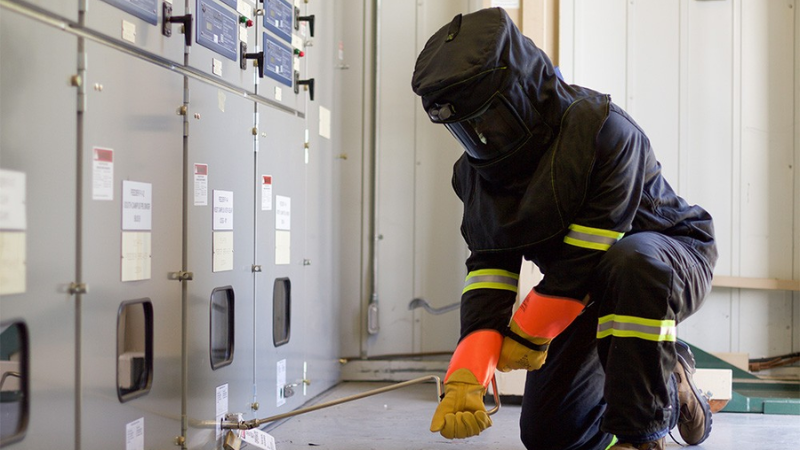
Based on the findings of the arc flash risk assessment, ERS provides PPE category requirements and recommendations addressing all OSHA standards. We can assist in the selection and supply of recommended equipment on which workers will be trained, and cover how PPE should be worn, maintained, and disposed of after its useful life has expired.
Preventive maintenance
NFPA 70E requires maintenance to be performed on electrical equipment in accordance with manufacturers' instructions or industry consensus standards. ERS develops optimized preventive maintenance programs that evaluate equipment condition and ensure your protective devices operate properly, safely, and reliably. Proper maintenance reduces prolonged arc flash exposure and often allows tasks to be accomplished safely without extensive PPE.
Documentation
Proper documentation ensures compliance with OSHA and NFPA standards and facilitates investigation should an arc flash related injury occur. ERS arc flash compliance documentation includes a customized written report with results of the arc flash risk assessment, updated single-line drawings, signs and labels on equipment, and all pertinent engineering data including incident energy at working distances, flash protection boundary, voltage, available fault current, and protective device description and trip time.
Optional annual recertification
As modifications or expansions to your electrical distribution system are made, or as changes occur in the electric utility system, it will be necessary to update arc flash assessment information on a regular basis. ERS can provide annual follow-up site visits to ensure continued compliance with applicable arc flash standards, practices, and regulations. The audit includes a written report of findings and recommendations.
See how ERS helps customers reduce arc flash risk

MANUFACTURING
Elevating Electrical Safety: ERS Delivers Rapid Arc Flash Study for Global Manufacturer
Full study on time and to code. All equipment compliant. Zero production disruption.

SEMICONDUCTOR
Staying Ahead: ERS Delivers Rapid Arc Flash Studies for Semiconductor Leader
Multi-site studies completed ahead of all compliance deadlines. Full compliance, no disruption.
"It was necessary for us to have one vendor for our arc flash, safety, and training programs. Based on our previous experience with Electrical Reliability Services, we knew we would receive world-class experience and solutions that would address all of our critical needs. We are very satisfied with every phase of the program we received."
Why ERS
Why facilities choose ERS for arc flash
- Nationwide PE staff, local delivery
ERS PEs are licensed across all 50 states. Multi-site customers get consistent, compliant deliverables without coordinating multiple regional vendors.
- NETA Level 3 and 4 certified technicians
A leader in staffing the highest field testing credentials available. Data collection performed by technicians qualified to the same standard your study will be audited against.
- 1.1 million completed projects
Deep infrastructure expertise across the entire electrical system. More than 1 million assets of equipment supported across all project work.
- Founding member of NETA
ERS helped build the testing standards the industry follows, giving our engineers direct insight into how those standards are applied and enforced in the field.
- Multisite capabilities
ERS coordinates arc flash studies across multiple facilities simultaneously, managing logistics, scheduling, and documentation for customers with complex multi-location operations.
- Standards authors, not just standards followers
ERS engineers participate in and lead standards development including NFPA, IEEE, and NETA. Your program reflects current requirements, not last cycle's interpretation.
- Integrated services, single engagement
Arc flash study, short circuit analysis, coordination study, labeling, and mitigation delivered by the same team under a documented quality program.
- Support available 24/7
Post-incident situations do not wait for business hours. ERS resolution center connects you to qualified technical resources including emergency support for arc flash incidents.
Industries we serve
Arc flash compliance across industries
Manufacturing
Production facilities face arc flash exposure at MCCs, switchgear, and distribution panels throughout the plant. Equipment age, deferred maintenance, and system modifications over time frequently invalidate existing studies. ERS deploys NETA-certified technicians and leverages existing facility knowledge to execute studies on tight timelines without disrupting production operations.
Data centers
High-density power infrastructure, continuous uptime requirements, and frequent expansion or reconfiguration make arc flash study currency a persistent compliance concern. The five-year NFPA 70E review cycle is a common driver, and zero tolerance for service disruption makes ERS field coordination a direct differentiator in this vertical.
Semiconductor and advanced manufacturing
Multi-site operations with tight production schedules and limited internal electrical safety expertise require a partner who can coordinate across locations simultaneously and deliver consistent results without disrupting operations.
Healthcare
Hospitals and healthcare facilities operate under Joint Commission and CMS oversight in addition to OSHA and NFPA 70E requirements. Essential electrical systems cannot be de-energized during maintenance, increasing arc flash risk and making accurate incident energy calculations and current PPE protocols critical.
Water and wastewater
Treatment facilities operate with aging electrical infrastructure and significant public safety obligations. OSHA 1910.269 compliance for electric power distribution systems is a common driver.
Commercial buildings and campuses
Large commercial facilities, universities, and corporate campuses with complex distribution systems benefit from comprehensive arc flash programs that address multiple buildings and voltage levels under a single engagement.
A complete electrical testing partner
ERS takes a holistic approach to electrical safety across your facility's entire lifecycle
From the moment a facility is energized to every modification, expansion, and reassessment that follows, ERS provides the full spectrum of electrical testing services under one provider. Arc flash studies are one part of a broader compliance and reliability program. ERS is equipped to serve you at every stage.
One provider. Every stage.

Arc flash testing FAQ
Have questions about arc flash testing, study requirements, compliance, or what to expect?
Documents and Downloads
*ERS does not provide professional engineering services in the state of North Carolina as defined in N.C. Gen. Stat. § 89C. Please contact us directly to determine whether these services are offered in your state.